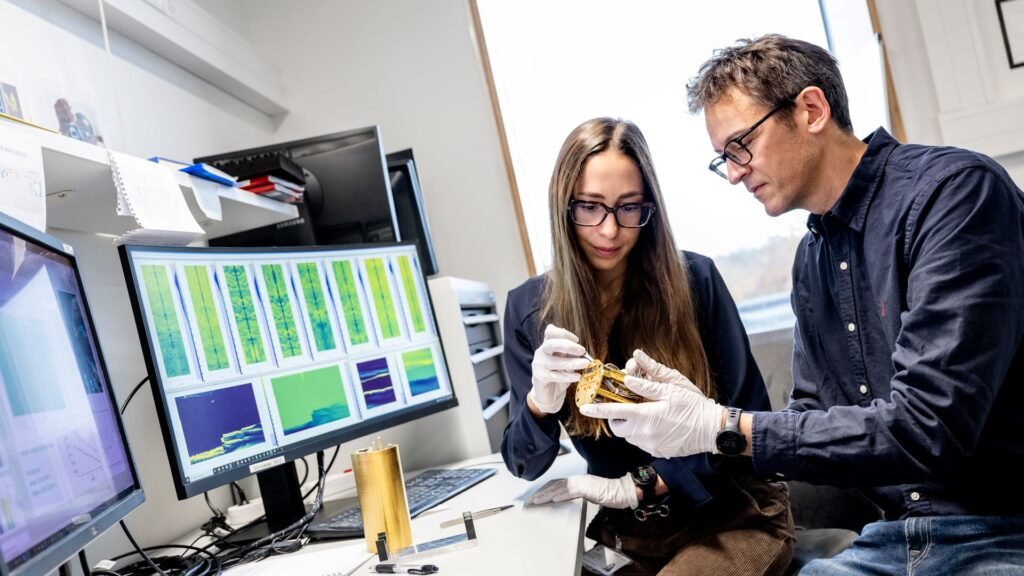
Researchers at Technical University of Denmark, led by Prof. Thomas Sand Jespersen, are investigating a new type of qubit using naturally occurring complex oxide crystals, such as strontium titanate, traditionally used in jewelry and energy technologies like batteries and fuel cells.
The team is studying the material at temperatures just above absolute zero to exploit its unique quantum properties, where electrons interact collectively, offering potential for faster and more controllable qubits. The research is conducted in collaboration with European partners from Italy, France, Sweden, and Poland.
Prof. Jespersen explained that the goal is to find qubits with full quantum-state control and precise readout capabilities, a critical requirement for reliable quantum computation. Complex oxides offer promising possibilities due to their strong electron interactions, which could lead to next-generation quantum computing architectures.
This work positions DTU as a leading center for quantum materials research, with state-of-the-art facilities for growing and testing functional oxides at Lyngby Campus.
Source: Technical University of Denmark
About the Author