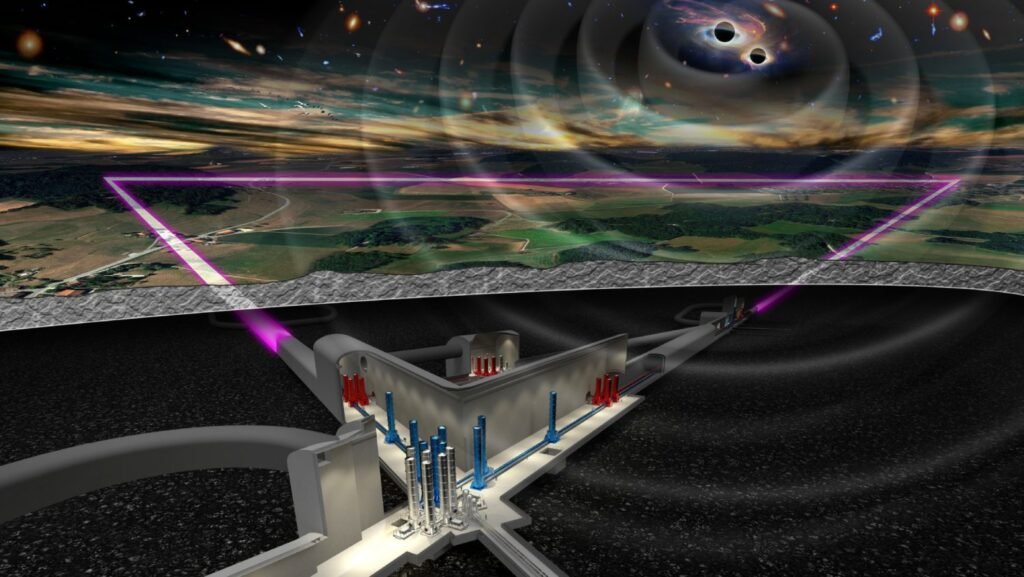
Ghent University (UGent) invites the public to explore the groundbreaking Einstein Telescope during its interactive roadshow in Ghent. The telescope, still in the planning stage, is designed to detect gravitational waves—ripples in spacetime caused by cosmic events such as colliding black holes and supernovae. These waves provide a new way to study the universe, beyond the 5% observable through light, potentially revealing insights into dark matter and even the Big Bang.
With three underground arms each ten kilometers long, the Einstein Telescope could detect a thousand times more gravitational waves than current detectors. Belgium, together with the Netherlands and Germany, is a candidate to host this revolutionary instrument at the tri-border area of the Maas-Rhine valley. Researchers at UGent and other Flemish universities are already tackling the technical challenges, from laser measurement to mirror coatings and steel construction for the planned 120 km of vacuum tubes.
The Einstein Telescope roadshow offers a hands-on experience:
- Walk through a VR version of the telescope
- Observe a virtual black hole up close
- Operate a mini Einstein Telescope yourself
- Learn about the physics and engineering behind this ambitious project
The free exhibition runs at UGent campus Ledeganck from February 26 to March 5, with VR and full experiences available on Sunday, March 1, and Thursday, March 5. Visitors can also combine their visit with the GUM, the Ghent University Museum. Additional lectures and school programs are offered throughout the week.
This roadshow highlights UGent’s role in advancing gravitational wave research, preparing for a future where the Einstein Telescope will open unprecedented windows into the universe.
Source: Ghent University
About the Author