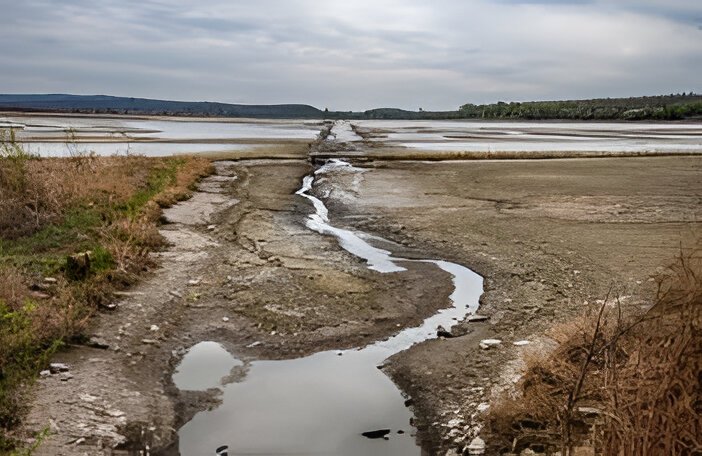
The Pátka Reservoir, once a key water source for Lake Velence, has not been in proper ecological condition for more than ten years, according to new research from ELTE’s Department of Environmental and Landscape Geography.
The study found that the reservoir’s dramatic decline in water quality was caused primarily not by surrounding agricultural activity, as often assumed, but by improper fisheries management and excessive nutrient loading. Researchers warn that restoring the reservoir is essential if Lake Velence is to have a secure water supply in the future.
The findings were published in the international scientific journal Hydrobiologia.
Four Decades Recorded in Lake Sediments
The research team, led by Dr. Enikő Magyari, analyzed a 54-centimeter sediment core extracted from the reservoir. By examining preserved pollen, chironomid (non-biting midge) remains, and conducting detailed geochemical analysis, the scientists reconstructed the ecological history of the reservoir from the 1980s to the present.
Their results revealed three clearly distinguishable periods.
Between 1983 and 1997, shortly after the reservoir was created, conditions were unstable. Drainage in the early 1990s followed by refilling disrupted the ecosystem. The sediment record showed dominance of species that tolerate low-oxygen conditions, alongside heavy sediment input and low biological productivity.
The period between 1997 and 2015 marked what researchers describe as the reservoir’s “golden age.” Stable water levels allowed submerged aquatic vegetation to thrive, oxygen conditions improved, and biodiversity increased. The reservoir functioned as a mesotrophic water body with balanced nutrient levels and healthy bottom-dwelling communities.
“This period represents the most favorable ecological state of the reservoir,” the researchers concluded, designating it as the reference condition for future restoration efforts.
After 2015, however, the situation changed dramatically. Sediment layers from 2015 to 2022 show a rapid increase in organic matter and a shift toward hypertrophic, oxygen-depleted conditions. Species associated with poor water quality reappeared, mass fish deaths occurred, and the reservoir eventually lost its water-supply function. It was drained in 2024.
Fisheries Management and Climate Pressures
According to Eszter Tombor, PhD student and first author of the study, the deterioration cannot be explained mainly by agricultural runoff.
“Our results suggest that intensive fish stocking and feeding practices, together with nutrient inputs from inflowing waters, played a decisive role,” she said.
The researchers also highlighted the influence of climate change. Increasingly extreme precipitation patterns in the region have intensified nutrient inflows. At the same time, diversion of the Császárvíz stream — the reservoir’s main inflow — has led to a higher proportion of treated municipal wastewater entering the system.
Restoration Is Crucial for Lake Velence
Given the reservoir’s long-standing role in replenishing Lake Velence, the team stresses that ecological rehabilitation is urgent.
Proposed measures include carefully planned dredging, stricter regulation of angling activity, increasing the proportion of predatory fish to stabilize the ecosystem, and improving the water quality of the Császárvíz stream.
The goal, researchers say, is to restore the stable and balanced conditions observed between 1997 and 2015.
The full study, Response of a shallow water reservoir to anthropogenic stressors: implications for the water supply of Lake Velence, was published in Hydrobiologia in 2026.
About the Author