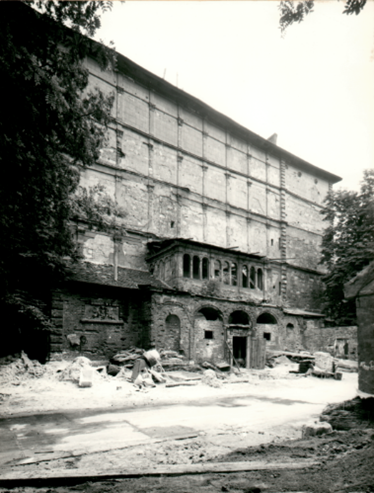
Karolyi Palace has a complex history shaped by post-war reconstruction and changing institutional use. According to a historical overview published by Pazmany Peter Catholic University, the palace went through several transformation plans and temporary uses between 1945 and the early 21st century.After suffering heavy damage during World War II, the building was initially considered as a future headquarters for the Hungarian Association of Architects in the early 1950s. Although the full renovation was never completed for this purpose, structural construction work began based on architectural plans prepared by architect Péter Molnár.In 1952, the building was temporarily leased to the Commissioned Goods Company for storage purposes. The company reinforced the damaged structure, installed temporary roofing, and carried out preservation work to protect valuable stored items. The palace later gained official monument protection status in 1958.From 1965 onward, the property came under the control of the Hungarian Radio, which planned to build a large concert hall on the site. Several architectural proposals were developed, including designs that would significantly transform the surrounding urban area. However, none of these ambitious plans were realized, and the palace continued to serve mainly administrative and storage functions.Over the following decades, the building housed offices, archives, workshops, and later even the Radio Museum, which showcased historic radio technology and broadcasting history. By the 2010s, many departments gradually moved out, leaving parts of the palace unused or functioning as storage areas.The historical study highlights how the Karolyi Palace has repeatedly adapted to new institutional roles while preserving its architectural heritage.
Source:Pazmany Peter Catholic University
About the Author