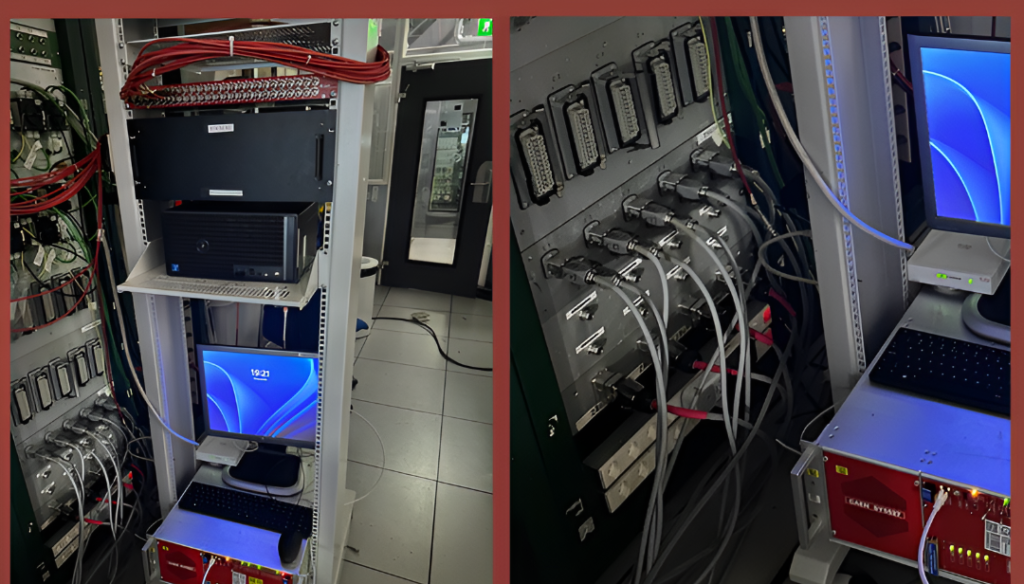
Researchers from the University of Debrecen have played a key role in developing a new testing system designed to ensure stability under extreme conditions at CERN, the European Organization for Nuclear Research.
CERN operates the world’s largest and most powerful particle accelerator, the 27-kilometer-long Large Hadron Collider (LHC). The facility accelerates protons and heavy ions to nearly the speed of light before colliding them at four major detectors: ATLAS, CMS, ALICE, and LHCb. These experiments allow scientists to study conditions similar to those of the early universe. The detectors function like giant high-speed 3D cameras, capturing up to 40 million particle collision snapshots per second while identifying stable particles and measuring their energy.
As part of its next major upgrade, CERN is preparing to launch the High-Luminosity LHC (HL-LHC), a priority project aimed at significantly increasing the number of particle collisions. While this upgrade will enable more precise experiments, it will also place unprecedented electrical loads on detector systems and monitoring electronics. Existing power supplies were not designed for such extreme conditions.
To address this challenge, researchers Balázs Ujvári, Melinda Orosz, and Zsolt Mátyus from the University of Debrecen and HUN-REN ATOMKI developed a specialized measuring device capable of simulating up to ten times the current load. The system allows comprehensive testing of detector behavior under extreme operational environments.
Balázs Ujvári, Assistant Professor at the Department of Data Science and Visualization at the Faculty of Informatics of the University of Debrecen, explained that the development includes an electronically switchable resistance network that simulates detector channel loads across a wide range. In addition, the team created a complete monitoring and testing electronics system along with user-friendly control software.
The prototype has already been presented and tested at CERN, where international experts conducted on-site measurements and provided feedback under real operating conditions. The system enables detailed and reliable examination of high-voltage power supplies, offering accurate predictions about long-term performance, early signs of wear, and potential failures. This helps identify which units may require replacement before the HL-LHC becomes operational.
Thanks to this innovation, the CMS DT sub-detector will be able to operate safely, stably, and with high precision even at significantly increased collision rates.
The research was supported by the National Research, Development and Innovation Office under project number NKFIH 2021-4.1.2-NEMZ_KI-2024-00043.
Source: University of Debrecen Researchers Contribute to CERN’s High-Luminosity LHC Upgrade
About the Author