As particle physics experiments push the limits of precision, researchers from the University of Debrecen are contributing to efforts aimed at meeting one of the biggest technological challenges at CERN: separating overlapping particle collisions in space and time.
At the heart of the issue is the High-Luminosity upgrade of the Large Hadron Collider (HLLHC), where increased collision intensity makes it increasingly difficult to distinguish individual particle events. Without highly accurate temporal data, reconstructing particle trajectories and determining physical quantities becomes significantly more complex.
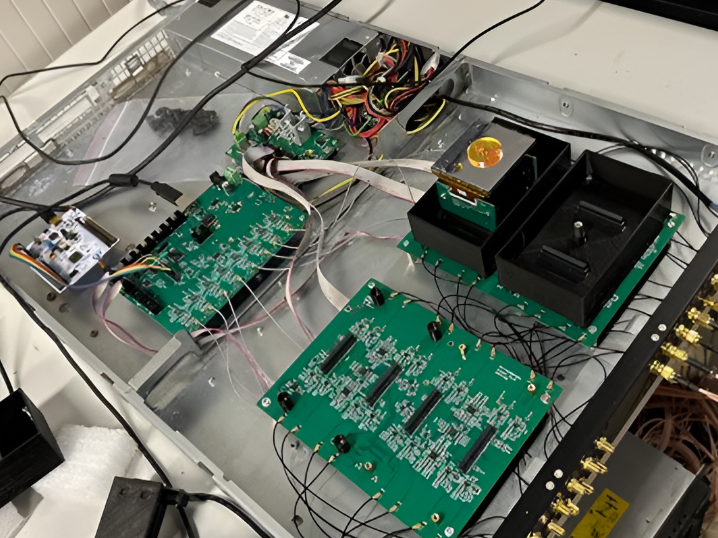
To address this, researchers in Debrecen have investigated and tested a crystal-SiPM-based detector designed to generate extremely fast electrical signals. The technology enables more precise identification of charged particles passing through the detector and improves the separation of simultaneous particle collisions and their decay products.
The detector system underwent testing using particle beams and picosecond lasers, allowing scientists to accurately and reproducibly characterize the temporal response of both readout electronics and detectors. According to Balázs Ujvári, Assistant Professor at the Department of Data Science and Visualization at the Faculty of Informatics, these measurements also allow direct comparison of development steps and refinement of the system’s performance.
Beyond fundamental physics, the technology carries practical implications. Similar timing-based detection methods are already used in medical imaging systems, where improved temporal resolution enhances image contrast while reducing necessary radiation exposure.
The project highlights the connection between basic research and applied science, demonstrating how developments linked to high-energy physics experiments can translate into socially beneficial technologies.
The research was supported by Hungary’s National Research, Development and Innovation Office under the 2021–4.1.2–NEMZ_KI–2024–00045 funding program.
Source: University of Debrecen
About the Author