Budapest, February 13 – What does it mean to build a career in the arts in Hungary today? Where can young artists find work, and how can they turn their ideas into sustainable ventures? These were the central questions explored during Workshop Week at the University of Theatre and Film Arts.
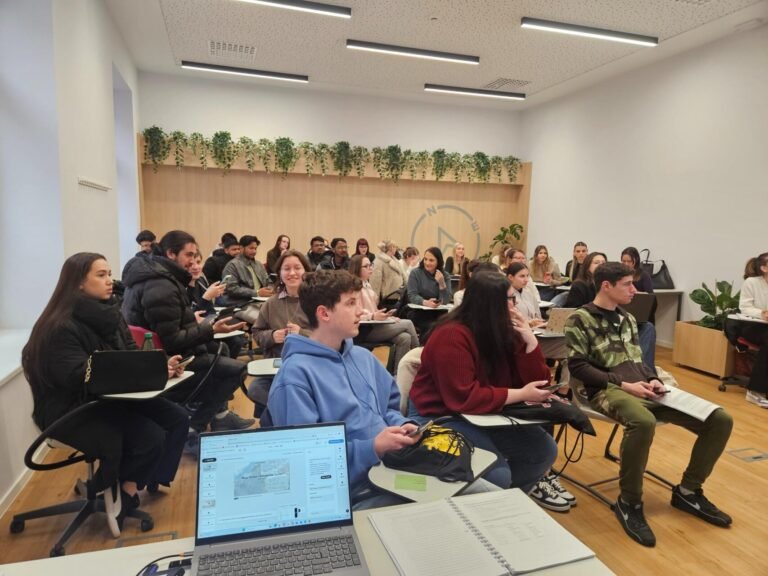
On February 12, Wild Monika, head of the university’s Career Office, addressed students in a candid and practical session about navigating the contemporary artistic landscape. From my seat in the audience, one message stood out clearly: the field is no longer confined to traditional stages or film sets. It has expanded.
Film and theatre remain important pillars, but streaming platforms, advertising, digital content production, and the events and festival sectors now form an equally significant part of the ecosystem. Rather than signaling fragmentation, Wild argued, this diversification reflects resilience. The one who can enter through multiple doors will succeed, she noted, a phrase that seemed to resonate strongly with the students present.
She encouraged participants to reflect honestly on their motivations. Are they driven primarily by the inner need to create, or by financial stability? While acknowledging the realities of earning a living, she warned that short term financial gains can sometimes divert artists from their long term professional identity. In a field where recognition and stability often fluctuate, clarity of purpose becomes essential.
Wild also addressed an uncomfortable but common reality: periods without work. Instead of viewing these moments as failure, she framed them as part of the natural rhythm of an artistic career. Downtime, she suggested, can serve as space for skill development, networking, research, or simply mental recovery. Artistic careers are rarely linear; they move in waves. Maintaining internal stability and self awareness may be as important as talent itself.
Practical advice followed theory. Students were urged to create a personal digital calling card, an online presence that clearly communicates who they are and what they do. For performers, the increasingly popular self tape format was highlighted as an innovative tool. Equally important, Wild stressed, is mastering a concise elevator pitch. In an industry built on encounters, often unexpected ones, being able to introduce oneself clearly and confidently can open doors.
Startup Opportunities for Creative Minds
The event also featured a presentation by Szvath Telkes Viktoria from the Hungarian Startup University Program, offering students a glimpse into entrepreneurship within the university environment.
The program is a two semester online startup training course delivered in English with Hungarian subtitles. During the first semester, students develop and submit a business idea in a one page concept format evaluated by partner universities. Those who successfully complete this stage can form three member teams in the second semester, where they receive mentorship and monthly scholarships of 65000 HUF to further develop their projects.
The most promising 15 teams are selected for a Demo Day, where participants can receive up to 1 million HUF per person. Graduates of the program automatically join the alumni network, maintaining long term professional connections beyond the classroom.
What became clear during the afternoon is that an artistic career today requires more than talent. It demands strategic thinking, adaptability, and a willingness to move between creative and entrepreneurial roles. For the students attending Workshop Week, the message was neither discouraging nor overly optimistic. It was realistic.
In the end, the session felt less like a lecture and more like a map, not one that promises a single destination, but one that acknowledges multiple paths.
Source: University of Theatre and Film Arts
About the Author