A new study from the University of Copenhagen challenges a common assumption in climate policy: wetlands do not need to be completely flooded to maximize their climate benefits. In fact, keeping the water table slightly below the soil surface may be far more effective in reducing harmful greenhouse gas emissions.
The findings, published in Nature Communications Earth & Environment, suggest that fully flooding peatlands can unintentionally boost methane emissions — a greenhouse gas up to 30 times more potent than carbon dioxide over a 100-year period.
Wetlands cover just six percent of the Earth’s land surface but store roughly 30 percent of terrestrial organic carbon. Because of this, their management plays a critical role in the global climate balance. In Denmark, authorities plan to flood 140,000 hectares of low-lying land under the Green Tripartite Agreement to reduce CO2 emissions from decomposing peat soils.
However, the new research indicates that total flooding may create ideal conditions for methane production.
“Most people expect that converted Danish low-lying soils will be flooded on a large scale. But our research shows that this is not a good idea,” said Professor Bo Elberling from the Department of Geosciences and Natural Resource Management. “By keeping the water level slightly below ground level, methane can be partly converted into the less harmful CO2 before it is released.”
According to the study, the optimal level is around 10 centimeters below the soil surface. At this depth, the balance between methane and CO2 emissions reaches what researchers call a climatic sweet spot. While the exact level may vary between wetlands — likely between 5 and 20 centimeters — the principle remains consistent: stable, subsurface water levels deliver the greatest climate benefit.
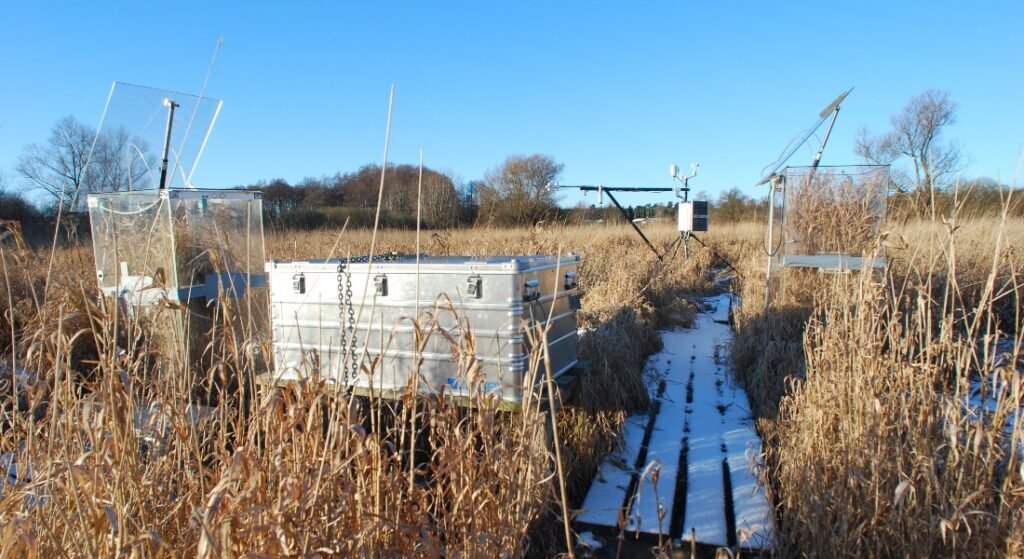
The research team based its conclusions on long-term measurements taken at Maglemosen, a peatland north of Copenhagen that has remained largely undisturbed for more than a century. Between 2007 and 2023, scientists continuously monitored methane and CO2 emissions, water levels, plant cover, and temperature, building a detailed model of the ecosystem’s climate performance.
The study highlights the importance of soil microorganisms. Methane is produced in oxygen-free layers deep in the soil, but near the surface methane-oxidizing microbes can convert methane into CO2 — provided oxygen is present. If the upper soil becomes fully flooded, oxygen disappears and this natural methane filter stops working.
Researchers also stress that vegetation plays a role. Certain plants transport oxygen into the soil but can also release methane directly into the atmosphere. Fluctuating water levels may additionally increase emissions of nitrous oxide, another powerful greenhouse gas.
The findings suggest that future wetland restoration projects should focus not simply on flooding land, but on maintaining a stable water level just below the surface to achieve the greatest climate benefit.
Source: University of Copenhagen
About the Author