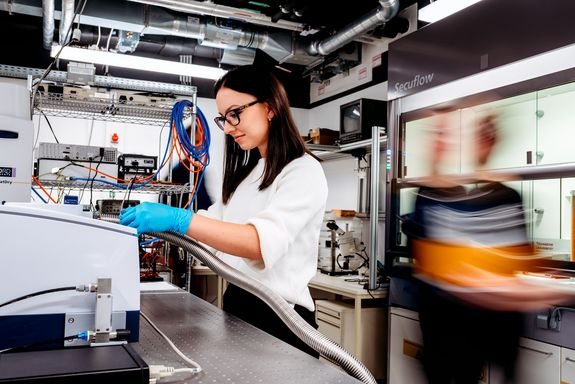
Austria | Researchers at TU Wien have developed a groundbreaking sensor technology capable of detecting extremely small amounts of environmental pollutants within minutes.The new method uses nanomembranes combined with infrared light to identify substances at nano- or picogram levels—far beyond the sensitivity of many existing techniques. What previously required days or weeks of analysis can now be achieved in as little as 15 to 45 minutes.Developed in collaboration with the spin-off company Invisible-Light Labs, the technology—commercially available as EMILIE—has already demonstrated strong performance in real-world applications. It can detect pollutants in both air and water, including fine particulate matter and nanoparticles.One of the key innovations lies in how particles interact with a tiny membrane. When exposed to infrared light, the particles slightly heat the membrane, causing subtle vibrations that can be precisely measured to identify chemical compositions.The system has been successfully used in diverse environments, from urban air pollution monitoring to studies in Arctic and Antarctic regions. It can even detect microscopic traces of materials, such as nanoparticles released from a tea bag into a small amount of liquid.Researchers say the technology represents a major advancement in environmental monitoring and could play a crucial role in improving pollution detection and supporting global sustainability efforts.
Source: TU Wien
#WordMain #StudentNewsPortal #Europe #studentnews
About the Author